Take a moment to upload your own invoices and test Nanonets OCR capabilities. Get a firsthand look at how it works on your own documents.
Invoice OCR is a technology that extracts data from invoices and financial documents, using machine learning and artificial intelligence. It enables businesses to automate accounts payable processes, reduce errors, and save time and money. By eliminating manual data entry, it reduces errors and ensures accurate financial records. With faster invoice processing, businesses can pay suppliers quickly and benefit from early payment discounts. Overall, invoice OCR leads to greater efficiency, improved accuracy, and cost savings for businesses of all sizes.
Free DemoNo need to spend time training an invoice OCR model from scratch - our solution already recognizes a wide variety of invoice fields.

Say goodbye to errors and hello to real-time document processing. Nanonets takes care of this and lets you focus on what matters most - your business.
Capture or import data from any source or in any format including, images, PDFs, scans, paper documents, emails, cloud storage, APIs and more.
Our OCR APIs have been rigorously tested and pre-trained on millions of documents, ensuring high accuracy and reliability from day one.
Set up completely automated workflows to handle file imports, data formatting, data validation, approvals, exports and integrations.
Reduce time spent on inefficient manual tasks and avoid data entry or validation errors that could burn a hold in your pocket.
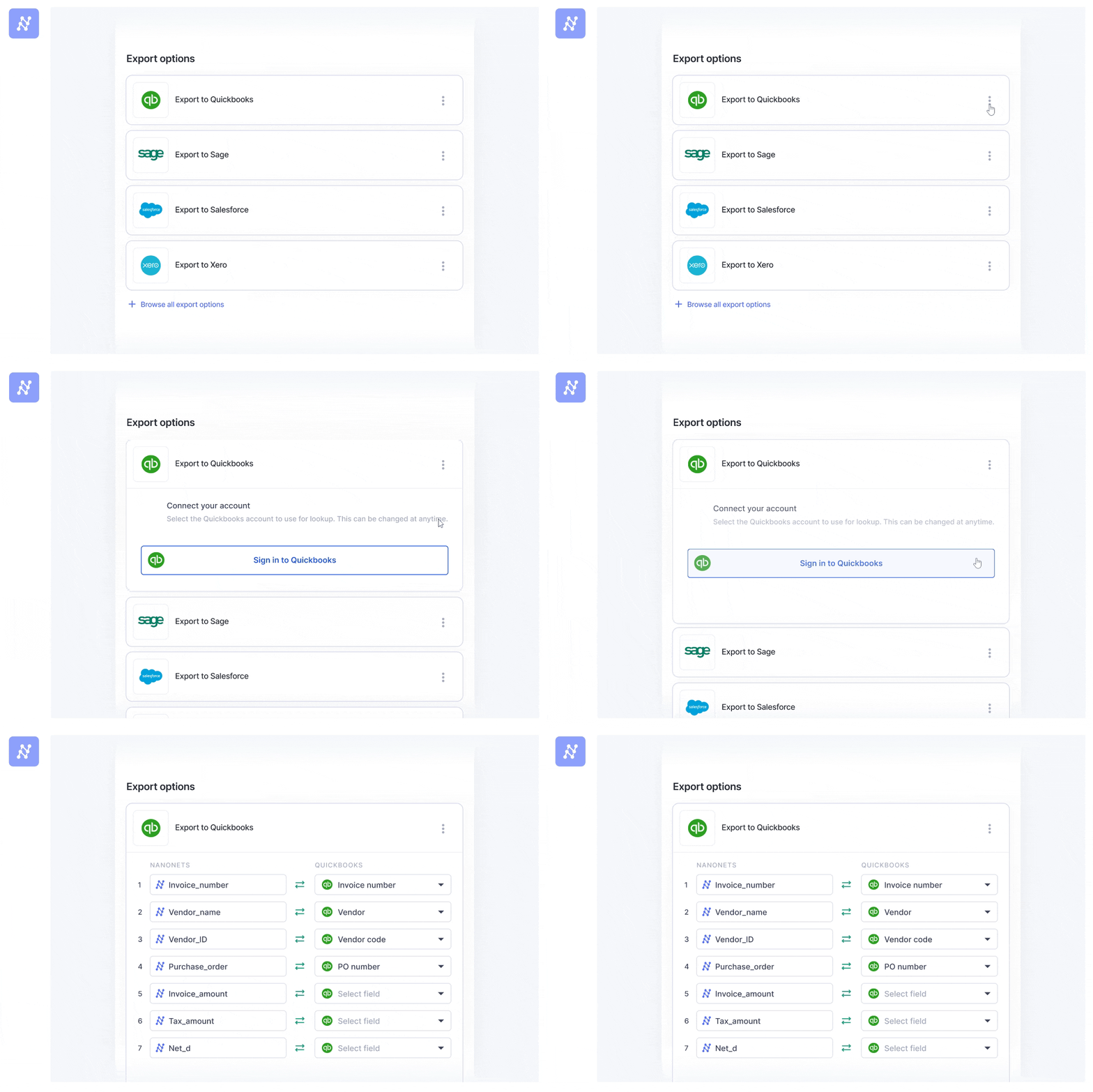
Integrate your existing business tools seamlessly with Nanonets to automate data collection, exports storage, bookkeeping, and much more.
Turn your organisation 10x more productive by allowing teams to focus entirely on core activities while Nanonets handles everything else.
Discover important details about our product.
Invoice OCR (Optical Character Recognition) is a technology that converts image-based or PDF invoices into machine-readable, structured data. It "reads" invoices, extracting key details like vendor, invoice number, date, and total amount. This automation eliminates manual data entry for accounts payable (AP) processes.
A robust Invoice OCR solution, especially one powered by AI like Nanonets, accurately extracts a comprehensive set of data fields from various invoice formats. These are critical for Accounts Payable (AP) automation, General Ledger (GL) coding, and financial reconciliation.
Key data fields extracted include:
How AI Ensures Accuracy: Nanonets uses sophisticated AI (Machine Learning, Natural Language Processing, Computer Vision) models trained on vast global invoices. This allows the AI to understand context, handle layouts agnostically, process scanned/handwritten data, extract complex tables, and allows for customization for unique invoice layouts or specific niche fields. This accurate data extraction transforms unstructured invoice documents into structured, actionable information.
AI and Machine Learning (ML) are fundamental to enhancing Invoice OCR accuracy, especially for highly variable invoice formats and challenging conditions that confound traditional OCR tools. AI enables the system to "understand" invoices like a human, rather than relying solely on fixed rules or templates.
This AI-driven approach enables Invoice OCR APIs to achieve significantly higher accuracy rates (often 95-99%+) across the unpredictable world of invoices.
Implementing Invoice OCR offers transformative benefits for businesses, significantly enhancing Accounts Payable (AP) efficiency, accuracy, financial control, and compliance.
Main benefits:
By transforming invoice processing, Invoice OCR empowers businesses with greater efficiency, accuracy, and control.
Yes, absolutely. Automating invoice data extraction with an Invoice OCR API significantly accelerates both invoice processing cycles and payment approvals. It eliminates bottlenecks inherent in manual AP workflows.
Here’s how it achieves this acceleration:
By automating invoice data extraction and integrating it into digital workflows, an Invoice OCR API transforms AP from a bottleneck into an agile and efficient financial process, leading to faster payments and improved cash flow.
Invoice OCR is a foundational technology within Accounts Payable (AP) automation workflows, serving as the intelligent data capture layer that transforms unstructured invoices into structured, actionable data for streamlined financial processes.
Here's how Invoice OCR is used in AP automation workflows:
Invoice OCR transforms AP from a manual data entry function into an efficient, accurate, and automated process, significantly enhancing financial control.
Integrating an Invoice OCR API into your existing financial systems or custom applications allows you to automate invoice data capture and seamlessly push structured data, eliminating manual entry and enhancing workflows.
Here's how to integrate:
By following these steps, you embed powerful Invoice OCR capabilities into your systems, automating invoice data entry and streamlining AP workflows.
Invoice OCR, while powerful, faces several common challenges, especially when dealing with real-world invoices. These challenges can impact accuracy and necessitate advanced AI solutions for effective processing.
Common challenges:
Overcoming these challenges requires a robust, AI-powered IDP solution like Nanonets, which leverages deep learning and continuous improvement (via human feedback) to maximize accuracy in real-world invoice processing.
Data privacy and security are paramount for an Invoice OCR API, especially when handling sensitive financial data (vendor bank details, transaction amounts, PII). Reputable providers implement robust measures to protect this data and ensure compliance with global regulations.
Essential data privacy and security measures:
By prioritizing these measures, businesses can confidently leverage Invoice OCR APIs to automate AP processes while rigorously protecting sensitive financial data and ensuring full compliance.
The market for Invoice OCR APIs and software is dynamic, featuring both dedicated Invoice OCR specialists and broader Intelligent Document Processing (IDP) platforms. The best fit often depends on specific needs like invoice volume, complexity, and integration requirements.
Leading providers:
When selecting, consider your invoice types (variety/complexity), required accuracy (especially for line items), scalability needs, and how seamlessly the solution integrates with your existing financial tech stack.
Automating invoice data extraction using OCR involves leveraging AI-powered Intelligent Document Processing (IDP) to transform manual processes into efficient, digital workflows.
Steps to automate:
This end-to-end automation drastically reduces manual effort, minimizes errors, and accelerates invoice processing.