Take a moment to upload your own purchase orders and test Nanonets OCR capabilities. Get a firsthand look at how it works on your own documents.

Purchase order OCR is a technology that utilizes artificial intelligence and machine learning algorithms to extract essential data from purchase orders. This data includes important details such as vendor information, purchase order number, quantity, price, and delivery date. With purchase order OCR, businesses can automate their procurement processes and ensure accurate data capture, reducing the risk of errors and time-consuming manual data entry. This technology enables companies to streamline their supply chain management, improve vendor management, and maintain better control over their inventory. By utilizing purchase order OCR, businesses can enhance their procurement efficiency and ultimately improve their bottom line.
Free DemoNo need to spend time training purchase order OCR model from scratch - our solution already recognizes a wide variety of PO fields.
.avif)
Say goodbye to errors and hello to real-time document processing. Nanonets takes care of this and lets you focus on what matters most - your business.
Capture or import data from any source or in any format including, images, PDFs, scans, paper documents, emails, cloud storage, APIs and more.
Our OCR APIs have been rigorously tested and pre-trained on millions of documents, ensuring high accuracy and reliability from day one.
Set up completely automated workflows to handle file imports, data formatting, data validation, approvals, exports and integrations.
Reduce time spent on inefficient manual tasks and avoid data entry or validation errors that could burn a hold in your pocket.
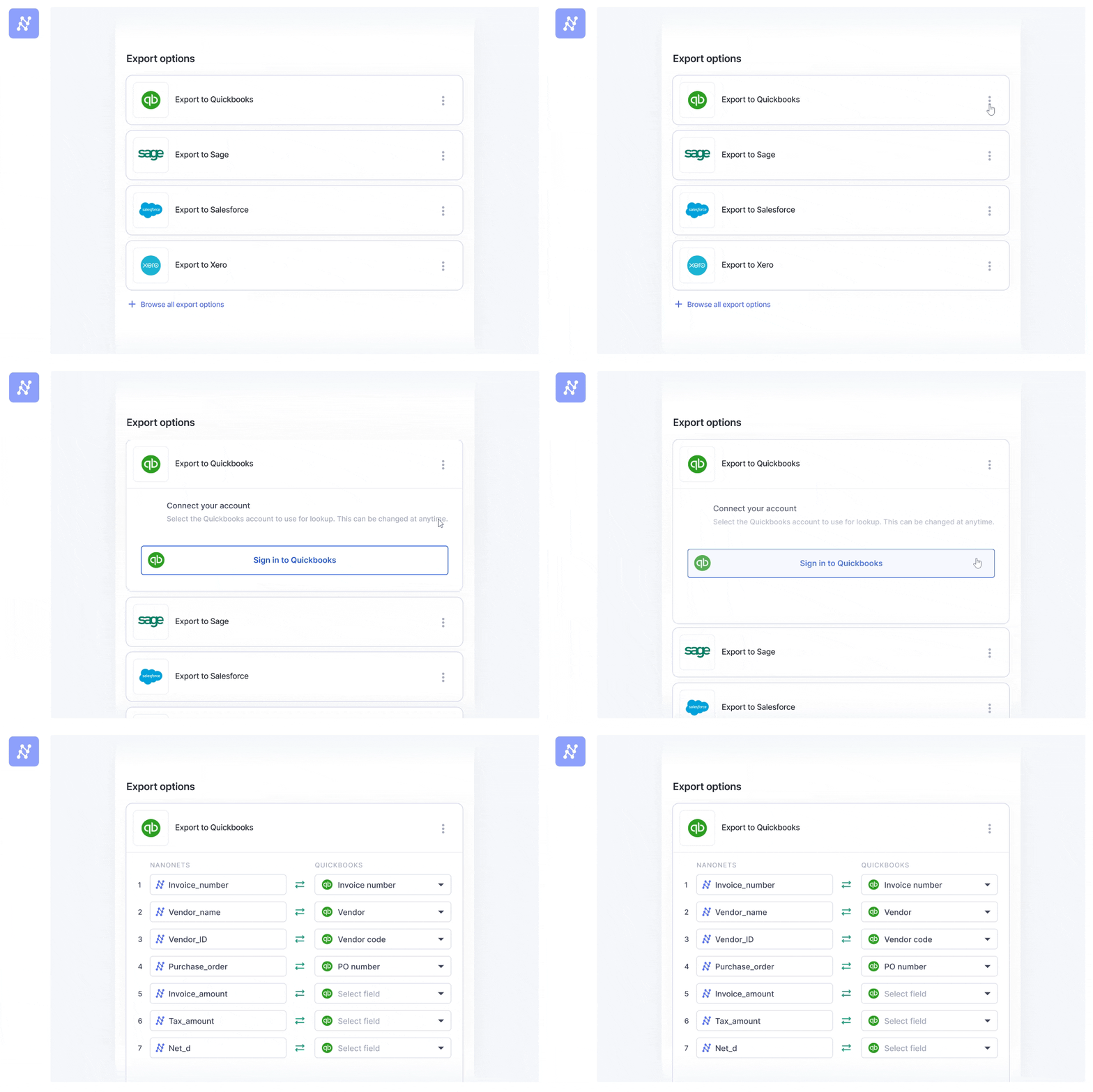
Integrate your existing business tools seamlessly with Nanonets to automate data collection, exports storage, bookkeeping, and much more.
Turn your organisation 10x more productive by allowing teams to focus entirely on core activities while Nanonets handles everything else.
Discover important details about our product.
The primary goal of using OCR (Optical Character Recognition) for Purchase Orders (POs) is to automate data extraction and streamline procurement workflows. It transforms POs (often PDFs or scanned images) into structured, machine-readable data.
Key objectives:
AI-powered PO OCR, like Nanonets', makes this automation highly accurate and efficient, optimizing the procure-to-pay process.
PO OCR APIs are designed to provide extracted data in standard, machine-readable formats, facilitating seamless integration with various business systems.
Typical output formats include:
Advanced APIs may also offer PDF with searchable text layer (original PDF enhanced for search) or direct integration (pushing data directly into popular ERP/procurement systems without an intermediate file). The flexibility ensures extracted PO data is easily consumed by diverse applications.
Yes, absolutely. A robust Purchase Order (PO) OCR API, especially one integrated within an Intelligent Document Processing (IDP) platform, can validate extracted data against master data (like vendor and product masters) and existing ERP records. This is crucial for data accuracy, fraud prevention, and automating the procure-to-pay cycle.
Here’s how it works:
By incorporating these validation capabilities, PO OCR APIs transform raw PO data into clean, verified information, enhancing data integrity and automating downstream procurement and AP workflows.
Purchase Order (PO) OCR fundamentally enhances financial accuracy, significantly reduces fraud risks, and dramatically improves audit readiness by automating document processing. These benefits are critical for robust financial control and compliance.
By leveraging PO OCR, businesses gain tighter financial control, reduce the risk of human-induced errors and fraud, and significantly streamline their audit processes, all contributing to a more robust financial posture.
Using Purchase Order (PO) OCR technology yields substantial cost savings by directly reducing manual labor, minimizing errors, and optimizing procurement and Accounts Payable (AP) processes. These savings contribute significantly to the overall Return on Investment (ROI) of the technology.
Key cost savings associated with PO OCR:
The combination of these factors typically leads to a very compelling ROI for PO OCR technology, often with payback periods measured in months, making it a highly justified investment for efficient procurement and financial management.
Purchase Order (PO) OCR plays a crucial and foundational role in automated invoice matching, which is a key component of Accounts Payable (AP) automation. Accurate PO data extraction is indispensable for ensuring invoices are correctly aligned with authorized purchases and received goods, leading to efficient, error-free payments.
Here are the key applications of PO OCR in automated invoice matching:
By providing clean, structured, and accurate PO data, Purchase Order OCR is a foundational technology that underpins highly efficient, automated invoice matching workflows, transforming AP from a cost center into a lean, controlled function.
Yes, absolutely. For popular procurement or ERP (Enterprise Resource Planning) platforms, pre-built connectors are widely available from leading AP automation and Intelligent Document Processing (IDP) providers. These connectors significantly simplify the integration process, often eliminating the need for extensive custom coding.
Here’s why and where you find them:
Common Platforms with Pre-built Connectors include ERPs (SAP, Oracle, NetSuite, Microsoft Dynamics 365, Infor, Sage), Procurement/P2P solutions (Coupa, Ariba, Zycus), and Accounting Software (QuickBooks, Xero). These pre-built connectors significantly lower the technical barrier for businesses wanting to automate their PO processing and related AP workflows.
Yes, absolutely. Scalability is a critical consideration for high-volume Purchase Order (PO) OCR API usage, especially for large enterprises or manufacturers that process thousands or millions of POs monthly. A robust API must handle increased load without performance degradation.
Key scalability considerations:
By selecting a PO OCR API built with high scalability in mind, businesses can confidently automate their procurement processes without worrying about performance bottlenecks as their volume grows.
Yes, absolutely. Most reputable Purchase Order (PO) OCR API providers understand the importance of allowing potential users to test their solution with real-world documents before committing. Therefore, free trials or demo versions are commonly available.
Here’s what you can typically expect:
To make the most of a free trial/demo: Use your own diverse PO documents, define success metrics, test edge cases, and, if possible, conduct a small-scale integration test with your ERP/procurement system.
Comparing different Purchase Order (PO) OCR API vendors involves evaluating their core strengths across accuracy, the breadth of features, and the flexibility of integration capabilities. Vendors often specialize, so the best fit depends on specific business needs and existing systems.
Key Takeaway: While all vendors aim for automation, Nanonets often stands out for its balanced approach: very high AI accuracy on diverse PO layouts (including complex line items), highly efficient custom model training for unique procurement documents, and strong, direct integration capabilities with major ERPs, making it a compelling choice for comprehensive PO automation.