

How Gordon Food Service uses LLMs for automation
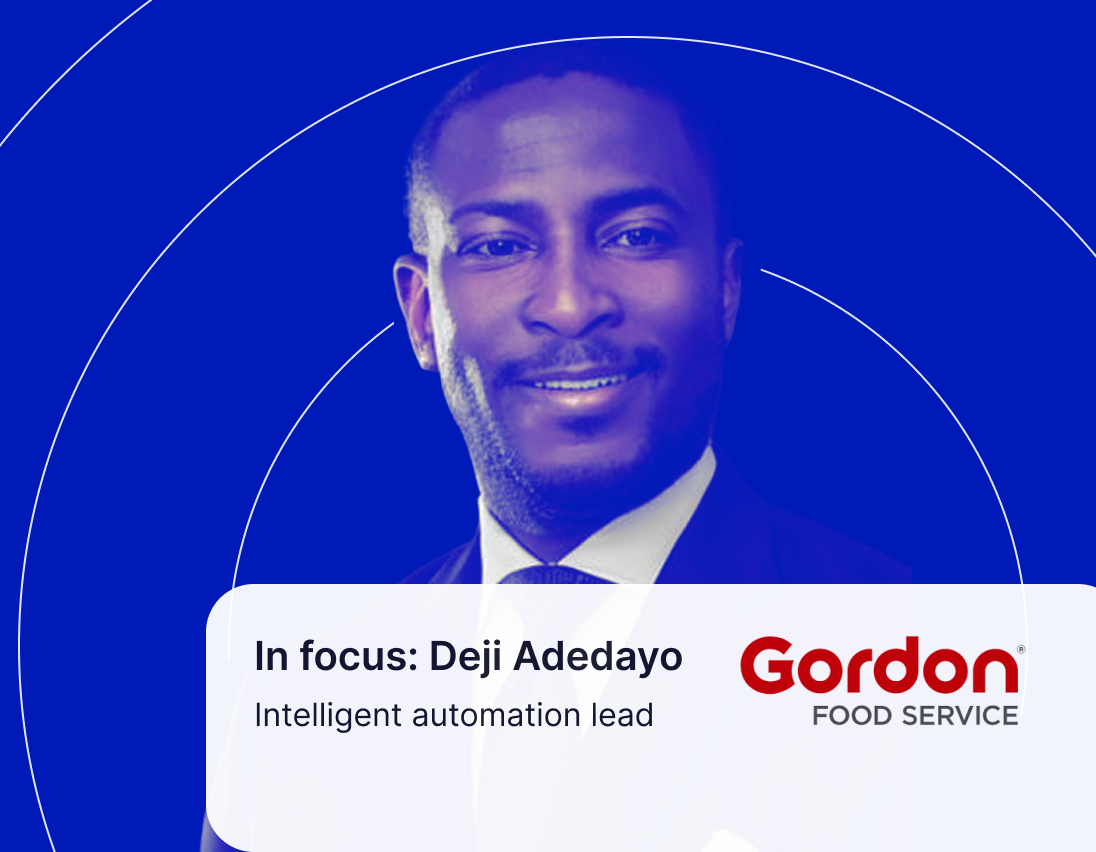
Deji Adedayo, Head of Intelligent Automation at Gordon Food Service, shares how a traditional food business became an AI champion, one automation at a time.
Accounts payable, product catalogue, supply chain - we take a look at what tools, processes, and people made automation not just possible, but successful.
Watch the full interview

Featuring
Highlights
Evangelising Automation:
From frustration to 93% accurate:
Building the Right Team:
Advice to automation teams:
Transcript

Sarthak
Today we have with us Deji, who heads Intelligent Automation at Gordon Foods Group. He’s been doing outstanding work integrating AI and automation across their operations. Great to have you here, Deji.
Deji
Thanks Sarthak, happy to be here.
Sarthak
To set the context, how do you personally define automation, and how is it shaping your world?
Automation philosophy
Deji
An illustration I often use - I forget where I heard it - is a security guard whose job is to keep a property safe. But he also has to manually turn lights on and off every day. While he’s doing that he’s not actually focused on security. Now imagine replacing those lights with motion sensors or automated timers. The guard is free to do what he was really hired for. We recruit people for their expertise, not the mundane tasks.
I like to explain automation by asking people to think about the tasks they find most frustrating in their day-to-day jobs. Imagine if those tasks could be handled automatically, with the result ready when you need it, and you never had to think about them again.
Sarthak
I love that example. People see AI generate images, write prose, make music, and then they're frustrated about, oh, if it's taking away all of the creative work that I love doing, why doesn't it just do the dishes for me? What’s the boring work that AI is automating for your team?
Deji
A good one is in finance. Say you hire a financial analyst to forecast business trends but they spend 80% of their day copying and pasting data into Excel. That’s a waste of talent. Same with creatives. You can take away those mundane tasks with bots, and really focus on the creative side of your work.
So a simple task as proofreading emails. Identify the trends in this data that I can't necessarily think about or see by myself. So it's not taking away anything from you.
Sarthak
You’ve seen the evolution from a pre-AI world, where all of this was a pipe dream, to a post AI world. What are you most excited about going forward?"
Deji's projects
Deji
I’m really excited about generative AI. It’s unlocked things a bunch of things we couldn’t do before. There was a time when we couldn’t do image classification for our products, we had to wait for vendors to supply us with usable images. Now, we generate those images ourselves, run an automated quality check, and they’re live on our website really quickly.
Another one is invoicing. Our previous process involved manually matching invoices, receipts, and purchase orders to make sure the quantity and amounts match. Invoices were send to our local offices, and then manually forwarded to our AP inbox. We could never catch-up to the volume of documents. It was pretty clear we needed to automate this.
We automated either ends of the process pretty quickly - email forwarding, export to SAP, payment processing. But the problem was - how do we extract all the information that we need from these documents and make sure it’s reconciling?
Initially we looked at the IDP tool of our automation vendor. It was so slow and clunky for our scale, ~500 documents daily. That’s when we switched to Gemini, and it’s worked great. We started with single page docs, and then multi-page. Today that automation runs with 93% accuracy. Invoices are paid on time, and there’s no manual intervention.
Sarthak
I have so many follow up questions. You shared two use cases. The first was generating product images for your website, something clearly unlocked by today’s AI.
The second, invoice payment automation, is something the industry has been trying to solve for 20 years, with older AI, then RPA, and now with generative AI, it's finally working. Why now? How much of this was technically possible even 10 years ago, and how much is only possible today? You mentioned 93% automation, was it a technology breakthrough like Gemini, or was it more about internal belief?
Deji
Great question. The technology has been a step change, but one of the biggest things I always fight against is organisational politics. According to studies by McKinsey, up to 70% of digital transformation initiatives fail due to internal politics, and Gartner just said 40% automation projects are also likely to shut down.
In our case, it’s not that we didn’t face pushback. People asked, Why not just use OCR? Why not stick with the IDP tool our vendor already provides? But the reality is, we tried IDP and it just didn’t work at scale. It was slow, clunky, and constantly needed tweaking. What made the difference is that we operate in a low-politics environment, so we said, why not try generative AI And we just went for it. Within a day, we had a basic prompt working on real invoices and from there, we kept refining. We had a team and leadership willing to try, fail, and learn fast without getting caught up in politics.
How long it took to automate
Sarthak
Once you had the prototype running, what did it take to actually get to where you are today, with the finance team trusting you?
Deji
Oh, to be honest with you, this sounds great right now but it wasn't great when we started off. The initial automation took around 6-8 weeks to build. But accounting for all the nuances in invoices, POs, and the process itself took us many months. I think it took us most of last year to get it done. We'd improve it, look at the data, and repeat. We had a kind of war room with the business team, to check what they were seeing on their side.
With the 93 percent accuracy we have now, there's still room for improvement. It really isn’t a 2-3 month thing.
Sarthak
The good thing about AI is it's learning and improving daily. But once you move from a great prototype to production, the end users immediately point out the errors. How did you take the team along that journey - knowing it’s not great today, but it will keep getting better? How did you build that patience?
Deji
That was tough. I believe in radical transparency - even if the data doesn’t speak well to me, I’ll still say, “This is what’s going on.” We need our business partners to work with us to build good automation. Without trust, it won’t work.
When we started Gemini, we were at 60% accuracy. At one point, people asked if we should go back to the IDP, it was working better. But I said, “Give us another week.” We started comparing data week to week, and the data improved. That’s when trust and buy-in really began.
It could’ve gone the other way, if things didn’t improve we might’ve switched back. But I believe in learning, failing, and moving on. That project was our first using generative AI, and it opened the floodgates. Now, if we had to build the same thing for another department, it would much less time.
Dealing with errors
Sarthak
Makes sense. Even at, say 97%, you have a small error rate. I like to use the analogy of self-driving cars where even a 1% error is not tolerable, so always there’ s person behind the wheel. Do you have a person “behind-the-wheel” supervising AI output?
Deji
I don’t believe in building automation and walking away, just saying Kumbaya guys good luck! I believe in continuous improvement - that’s my Lean Six Sigma background. Even at 93 or 96% accuracy, I aim for 100%.
For every automation, we track KPIs on dashboards, especially accuracy. Then we look at the exceptions that leads to inaccuracy. For example the vendor may not have sent the right document. We review whether exceptions are system-related or business-related. We meet all automation stakeholders monthly, with the biggest bucket of problems, and focus on finding resolutions.
So, to remove that person from the wheel and make it fully autonomous, it's important to keep track of the data. That is what would help you get your hands off the wheels metaphorically permanently at some point.
The GFS automation squad
Sarthak
What kind of team do you build for projects like catalog image classification or invoice processing? Engineers, analysts, business folks?
Deji
I like to think of it like a car service centre. When you bring in your car, someone greets you and notes the issue, and then a mechanic fixes the car, and someone else returns it when it’s done. The automation team works similarly. You need someone who can translate business needs into technical language. I prefer developers to focus on building, so I like having an analyst or business liaison in the middle to ensure nothing is lost in translation. You need a good data analyst - this is key - someone who can build dashboards, track KPIs, identify trends. And of course, you need engineers.
I’m less concerned about what tools someone already knows. There are too many to master them all. And I don’t want someone who’s stuck on “I only use Blue Prism.”
Sarthak
How do you choose what to automate?
Deji
I get this question a lot. I start by meeting the business stakeholders personally. The key is: don’t bring me a solution, bring me the problem. Once I understand the problem, I start mapping out possible approaches.
ROI is obviously important - but people don’t think about things like that. How does the process impact upstream or downstream teams? Does it affect customer satisfaction or revenue? For instance, a team might want to automate inbox sorting. That’s great. But the real benefit might be reducing customer response time from 48 to 8 hours. That can improve satisfaction and retention, which directly affects revenue. We ask questions like, “Have we lost customers because of slow responses?” If so, we document that, it strengthens the case for automation.
Sarthak
Let’s talk about impact. AI can improve top line, bottom line, customer experience, employee experience, or just reduce complexity. Where are you seeing the biggest impact?
Deji
I’d say, employee morale. That’s an area we often overlook. When AI automates repetitive tasks like image classification or invoice processing people can stop worrying about it.
I’d say, employee morale. That’s an area we often overlook. When AI automates repetitive tasks like image classification or invoice processing people can stop worrying about it.
What's next and advice for automation teams
Sarthak
What’s next for you? Where do you see the biggest opportunities?
Deji
I think supply chain. I think GenAI will be transformative there. We’re just scratching the surface.
I heard about, in Oklahoma I think, city trucks using mounted cameras and GenAI to detect road issues. It flags what needs fixing, estimates materials, and sends alerts. That same concept applies to warehouses and logistics. We scan tons of boxes and equipment today, often manually or with slow scanners. Imagine using cameras with GenAI to read labels and put them into a data lake.I think it's going to be amazing. It's a huge opportunity there.
Sarthak
Let’s say a company is just getting started with automation. What’s a good first step?
Deji
Start with finance. I think it’s a great place because people are doing a lot of copy pasting, downloading reports, exporting to SAP. We began with finance, then expanded to master data and other areas.
But it’s not just about where you start, it’s also about how. Evangelise. Visually show people what’s possible. For instance, we built an automation that pulls reports from multiple vendor websites like UPS or FedEx for payment processing, something that was fully manual before. Small wins like that build credibility fast.
Sarthak
Let’s fast-forward. Ten years from now, you’re the only person working at Gordon Foods, and everything else is automated. Is that where we’re headed?
Deji
Haha, don’t make se sound like an evil warlord! But seriously, every industrial revolution has led to new types of work, and this one will too. Like prompt engineering, which barely existed two years ago. I think it's a good time to look at where you can make impact within the organisation. Key into AI and see how AI can help improve your work."
Sarthak
Any closing thoughts or advice?
Deji
Don’t be afraid to fail. Try things, break things, learn fast, and adjust. That mindset helps you move quickly and build momentum. And evangelise. A lot of people don’t understand automation, some are afraid of it, some just don’t see the value. The more you show them what’s possible, the more support and traction you’ll gain. I call myself an “automation evangelist” for that reason.
Sarthak
That’s incredible. Deji, thank you for joining us.
More from Nanonets

Asian Paints
Nanonets helped automate invoice processing at Asian Paints saving 90% of the time spent in managing Accounts Payable saving 192 hours per month.

JTI Ukraine
Nanonets helped automate the tax refund process bringing the turnaround time down from 24 weeks to 1 week or less, making the process 96% more efficient.

Suzano
Nanonets helped automate the purchase order processing at Suzano International, Austria reducing the time taken per purchase order from 8 minutes to 48 seconds, a 90% reduction.