

Cutting through the AI noise
Diageo, the $20B powerhouse behind iconic brands like Johnnie Walker and Tanqueray, faces the same question echoing across boardrooms today: to AI or not to AI?
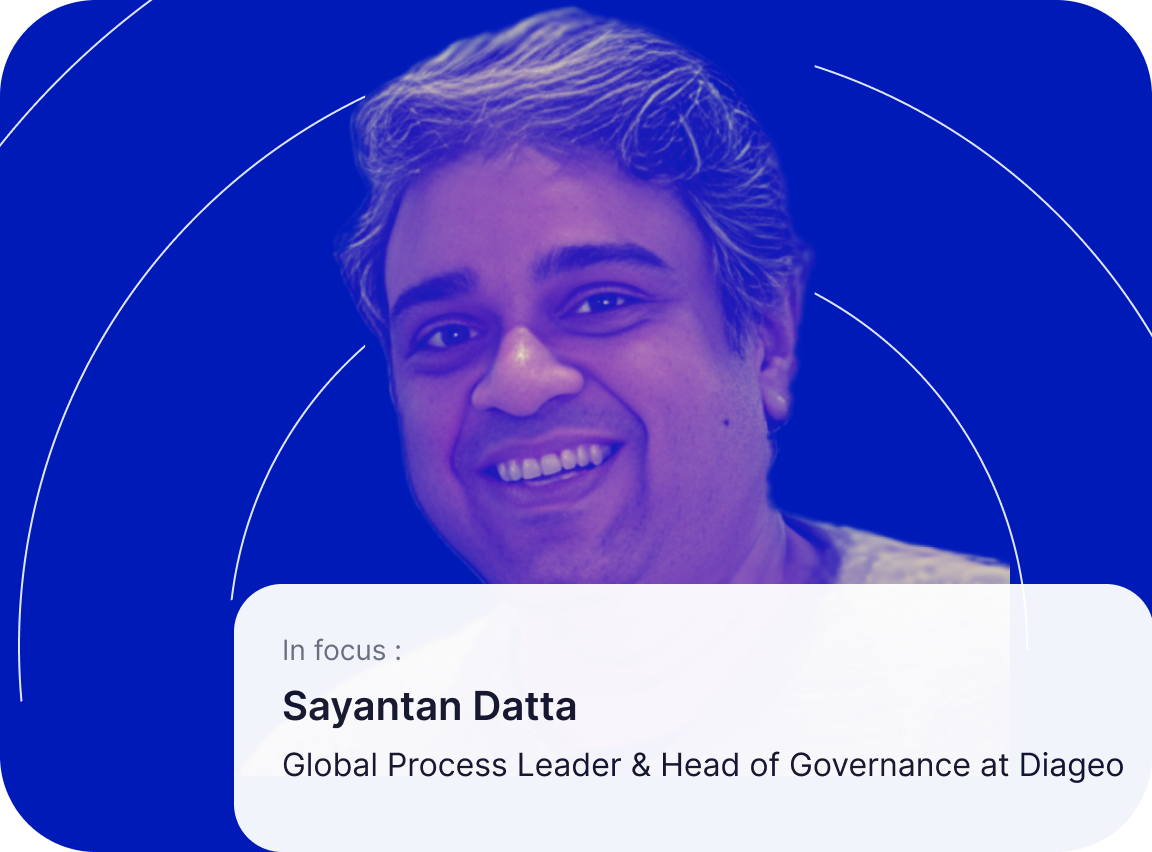
Sayantan Datta, who heads the Order to Cash Process at Diageo, and brings over a decade of experience driving automation projects at SIs, is a (cautious) optimist. We talk to him about his philosophy and practical approach to automation projects.
Watch the full interview

Featuring
Anirudh Patri (Growth, Nanonets AI Agents)
Highlights
Avoiding the AI theatre
Data is the key
Mindset shift
Transcript

Anirudh
Hi, everyone. Welcome to the Nanonets Podcast. Nanonets is an AI platform transforming how enterprises reimagine their processes. I'm Anirudh Patri, a GTM leader at Nanonets and an AI enthusiast.
Today I have with me Sayantan Datta, SVP Global Process Leader at Diageo, a company that owns familiar brands like Guinness, Tanqueray, and Captain Morgan. Sayantan is responsible for transforming a multitude of business processes at Diageo and brings a wealth of knowledge around automation.
Sayantan
You missed out Johnnie Walker. That’s the most important one!
What automation means to me
Anirudh
Of course! So to set the stage, what is automation to you? How do you see it evolving? How has it changed the world over the past few years?
Sayantan
Automation has gone through several generations. Early in my career, it meant simple things like building Excel macros or mainframe screen scraping. It's come a long way in the last 15–17 years to a point where we now have conversations that would've seemed sci-fi even 10 years ago, around immersive technologies and the capabilities of AI.
To me, automation is about doing things better and creating better experiences, not just automating tasks for the sake of it. If something doesn't make sense to do, I'd rather eliminate it than automate it. Automation should drive better experiences for customers, stakeholders, and employees.
Anirudh
What does automation look like today? Why is it so different from five or ten years ago?
Sayantan
We've created marketing wrappers around automation. That’s led to the hype, automation became something you must have. It's the cool thing. You're not at the table without a point of view on it.
Second, technology has advanced significantly in the last 10-12 years. We've developed tools that let you operate at a scale that never made business sense before, at speeds that weren't possible before, and with skill sets that don’t require deep technical expertise. You don’t need to be a rocket scientist anymore. You can build simple no-code flows yourself. So the technology is more powerful, more accessible, and more sophisticated.
Outcome first vs Feature first
Anirudh
A lot of people are struggling with new offerings from legacy players like UiPath or Blue Prism, and from startups, all claiming to automate processes end to end. How do you cut through the noise? With new tools launching every day, how do you focus on what's actually important?
Sayantan
That noise is everywhere. I didn’t even mention AI earlier, and that’s intentional. The way AI is marketed today, it’s like we have the solution already painted and now we’re looking for a problem. The organisations that succeed start with the problem. What do I really need to get done? What outcome do I want? That clarity makes it easy to cut through the noise. You’re not starting with features, you start with needs and outcomes. Then you move to features, and from there to benefits.
If you start with features, that’s when the noise sets in. Every product leads with features: "I can do this, I can do that, mine is better." Right now, it’s agentic AI. A few minutes ago, it was generative AI. The conversation is stuck on features. Instead, we need to hear: “Here’s a problem I can help you solve.” That’s how you cut through the noise.
Anirudh
Let’s take a process like contract lifecycle management. Say your goal is to increase efficiency. How do you approach automation? Do you reimagine the process from scratch? Or do you work with the existing process and focus on the bottlenecks?
Sayantan
When I approach transformation, I always start from zero base. If I had to manage contracts ideally, I wouldn't need to touch the contract document. I’d define the objectives and boundaries, and begin execution.
From a contract perspective, especially on the demand side, a customer wants a few key things: agreed pricing, agreed products, and the right format. That’s the need. Now, how can I make that happen? There are three aspects to the process. First, the underlying data, making it as clean as possible. Second, the milestones from jotting down notes to creating a living document both parties agree on. Third, how my customer experiences that document.
So, the outcomes are: Data accuracy, consistency and integrity of the process, great experience for the customer. When we talk automation or transformation, we need to look at all three layers, preferably starting at the top:
- What’s the experience I want to deliver?
- What should the process look like to deliver that experience?
- What data and documentation are needed to support it?
Once that's clear, then you look at tools. Some contract lifecycle tools come bundled with CRM or trade investment systems. What features do I really need? Where do I get the most benefit?
And finally, before implementation, what needs to be true for the solution to work? The answer is almost always: clean data. Otherwise, you spend millions, get distracted by the next trend, and end up with a stack of half-finished innovations, none of which really work.
Data is the key
Anirudh
Data seems to be one of the biggest challenges in automating any process. How do you overcome that, especially in large enterprises with multiple brands and acquisitions? And what are some of the other challenges you’ve faced?
Sayantan
Data is a living problem. We’ve been trying to solve it as a finite task, but it evolves as businesses evolve, new products, new systems, new ways people interact. You’ll never "solve" data. The goal is to understand the gaps and use what you have to deliver the needed outcomes.
That means having a framework to continuously assess and improve data, keep enriching it rather than chasing a mythical single source of truth. We’ve been trying that since SCADA systems, and we’re still not there. Instead of chasing perfect data, focus on making it better, continuously.
Another challenge is the belief that "my business is unique." That mindset creates cultural inertia. If you believe nothing off-the-shelf can work, you'll constantly chase new features without ever solving the core issue. But 60–70% of business processes are similar across companies. Start by addressing that common foundation, data, milestones, experience, and you’ll make real progress.
We also suffer from transformation fatigue. Too many priorities, limited people, and no focus. We try to do 50 things at once and finish none. We need to focus on five things, finish them, then move on.
Zero-based approach
Anirudh
I was a consultant for a while, and we’d often give clients a list of 100 things to improve. But as you said, most of those aren’t even necessary. How do you boil 50 potential projects down to the top five?
Sayantan
If there are 50 things to fix in one part of the business, that part needs a redesign. Let’s take accounts payable or receivable. If you can list 50 things to change, something fundamental is broken. Go back to the basics: what do I need this process to deliver? What outcome do I want Once you start from need and outcome, the list naturally narrows to a few key things.
Take cash application, for example. You’ll hear: customer hierarchy is broken, sub-ledgers aren’t right, multiple bank accounts, etc. But nobody asks: why do I do cash application? The purpose is to maintain a clean book of records, so I can serve customers, stay compliant, and close books efficiently. The real solution lies upstream.
If your business has too much low-value work to automate, your foundation is weak. Fix the foundation first. Then you only need three or four improvements, not 50. Don’t start with a tool and look for problems it can solve. That’s how we end up with endless lists.
Anirudh
I feel that way about my wardrobe too. If I have too many things I don’t use, I probably don’t have the right things. Scrap it all and rebuild it.
Sayantan
Always zero base.
Anirudh
I’ve seen a lot of reluctance to go zero base. For example, someone might say, “I’ve already spent so much on Workday CLM. It’s implemented by Deloitte. I have a big team running it, I can’t just scrap it.” How realistic is zero basing in that situation?
Sayantan
It’s extremely difficult. It’s like being a kid who did something wrong and now you're wondering if you should tell your parents or try to cover it up by doing more wrong things. It comes down to human behavior. I made a choice, it didn’t work out. Now, do I keep investing to justify that choice, or just accept it failed and move on? That shift in mindset is crucial.
Anirudh
Is it possible that the original decision was the right one at the time, but given how fast things change, it just doesn’t make sense anymore?
Sayantan
The mistake isn’t usually about picking the wrong software. The mistake is not being clear about what problem we’re solving. Think about what an ERP provides: a data foundation and basic processes to keep that data relevant and accurate. But then we start using ERP to drive automation, customer experience, even AI. That’s when we chase features without needs.
Whether it's SAP, Oracle, Workday, JD Edwards, none of these are wrong choices for keeping good accounting records. They all do that well. But when we try to use ERP to solve everything, we create data silos and inefficiencies. That’s where the problem starts.
The culture shift
Anirudh
If you had a magic wand to redesign a company for AI and automation adoption, what would you change?
Sayantan
Two things. First, I’d change the culture and the way people look at AI. I’m a process guy. My first job was making process maps. AI won’t magically solve business problems. Businesses have problems because of how they’re structured, their customers, and regulations. AI should enable solutions, not be the solution. You don’t need a Ferrari to buy groceries, unless your goal is just to show off the Ferrari.
Second, despite all the hype, true AI adoption is still complex. Most people don’t code. I still marvel at pivot tables. There’s a big gap between where most people are and where they need to be to actually use AI. If I had that wand, I’d close that gap, make it possible for the average semi-skilled person with common sense and basic computer skills to use AI effectively.
That’s when we’ll see real adoption. If someone doing accounting can’t use AI without a big IT team, we’re not really adopting it, we’re just wasting money driving that Ferrari to the grocery store.
Anirudh
Totally. That idea of making AI usable by regular people is so important. It reminds me of the late ‘90s when everyone was rushing to get certified in ERP tools like SAP or Oracle. Now it’s Google AI certifications. But we’re not unlocking AI for the entire company.
And yes, pivot tables. Still magical. Since we’re on the topic of making AI more accessible, do you have a take on how companies like OpenAI or Anthropic can make AI more enterprise-friendly, so more people in your team can actually use it to improve their day-to-day work?
Sayantan
If you look at companies genuinely successful with AI, not just in valuation or VC funding, they focus on experience. Instead of creating hypothetical monetization paths, they ask: how does this improve everyday life?
I still face accounting problems that no AI has been built for. Some issues happen once every few years. For example, I had a client where mid-shipment, customs regulations changed in the receiving country. The container sat at the port while people debated who would own the credit note if they dumped the goods. That’s not a problem AI currently solves.
We need solutions that predict and prepare for these rare occurrences. Instead, many companies are building AI to do swivel-chair tasks, copying and pasting data, summarizing emails. But the real problem is: why do we have so many emails in the first place?
We need to stop chasing valuations and start chasing value.
Anirudh
So, going back to the Ferrari example, AI shouldn’t just be doing basic errands. It should be solving complex, high-speed problems.
Sayantan
Exactly.
Anirudh
You’ve spoken about human-augmented design, where AI adapts to unpredictable human behavior, not the other way around. What are two or three ways to make that happen?
Sayantan
First, we have to accept that humans behave differently in the same situation on different days. Today I might use an umbrella in the rain. Tomorrow, a raincoat. The next day, I might just get wet for fun. That unpredictability scales. One choice influences others, creating a web of decisions. As long as humans are in the loop, and I hope they always are, we need to account for that in AI design.
AI is supposed to predict exceptions, but when an exception occurs, it often needs human judgment because there’s no single correct answer. We need AI that allows space for that unpredictability instead of just trying to force a 90% prediction into human decisions.
When you try to push machine-made decisions into human life, people resist, especially in traditional organizations. In a warehouse, someone knows exactly which aisle has mislabeled inventory. If you impose AI without involving them, they push back.
That’s why I say we need human-augmented AI, AI that becomes more effective through human insight. The future of work is in making space for human judgment in AI systems. Yes, AI can write contracts and briefs, but...
Anirudh
But it can’t eliminate the human element.
Sayantan
Exactly. The end consumer of AI’s output is still a person. You have to start with the human need and build backward. Not build features and expect people to conform. That goes against everything in marketing. Kotler would be turning in his sleep.
Anirudh
Since we’re talking about humans making decisions and work being automated, what skills should someone build to stay relevant? Say, the next person in your role, or a college grad?
Sayantan
I admire how people in their 70s and 80s now make UPI payments. When they were teens, technology meant landlines, TVs with knobs, FM radios. Now they use smartphones and even autonomous cars. What allowed that leap? Adaptability. Change is scary because we fear what we don’t understand. But adaptability, being able to learn and apply new things, isn’t taught as a skill. Many people wait for someone to tell them what course to take or what tech to learn. But change is constant and accelerating.
You don’t need to master AI or be a math genius or coder. What you need is the ability to learn, adapt, and not be overwhelmed. We need to move from saying “why not.” as a full stop to “why not?” as a mindset shift. That’s the future skill.
Anirudh
And that ties back to the cultural shift enterprises need to evolve at the same pace. Ten years down the line, or even 50, how do you see a company the size of Diageo operating? What will be the roles of humans and AI?
Sayantan
It's a very difficult question to answer because it means thinking about how the world’s going to change in 10, 15, 50 years. You have to consider politics, geography, regulatory frameworks. Will we be operating on one currency? Will we shift to cryptocurrencies entirely? It’s difficult to predict. If you were sitting 10 years before today, would you have expected what we see now? At the time, something like Minority Report seemed extraordinary. Now, it's not far-fetched, people are talking about putting chips in your head.
I think what will change in how organisations operate is a shift toward focusing more on experiences. We’re still far from that being real, but at least we’re talking about it, experience as an outcome that equals efficiency and effectiveness. Future individuals will spend more of their time creating hyper-customised experiences. What “good experience” means for you versus me should be different. Technology should help us expect better for ourselves.
So, my experience of eating an ice cream versus yours will be different, and people will be focused on delivering that experience on demand. Not via focus groups and 10-year innovation cycles, but in real time. Execution on demand, not just prediction, will drive the future, subject to regulatory, political, geographic constraints, and even whether having ice cream is politically correct in the future.
Anirudh
We’re almost at the end. One last question, if you could make a magic app, what would it be? For me, it would be a music app that generates music exactly the way I want, so I don't waste time finding songs I enjoy.
Sayantan
That opens up a lot of wish lists. Right now, if you could build me an app that helps me manage my emails and classify them so I can look them up easily, that would be miraculous. There’s progress in robotics and voice-driven copilots, and I still struggle with managing emails. If you can give me an app that helps turn emails into actionable tasks and execute them efficiently, that would be it.
Anirudh
Opening my email after a long leave is my biggest nightmare. Alright, thank you for your time today, Sayantan.
More from Nanonets

Gordon Food Services
Deji Adedayo led Gordon Food Service’s AI journey, starting with invoice automation that achieved 93% touchless processing.

Asian Paints
Nanonets helped automate invoice processing at Asian Paints saving 90% of the time spent in managing Accounts Payable saving 192 hours per month.

JTI Ukraine
Nanonets helped automate the tax refund process bringing the turnaround time down from 24 weeks to 1 week or less, making the process 96% more efficient.