Take a moment to upload your own bills of lading and test Nanonets OCR capabilities. Get a firsthand look at how it works on your own documents.
.avif)
Bill of lading OCR is a technology that uses optical character recognition (OCR) and machine learning to extract relevant data from bills of lading, a legal document that is required for the shipment of goods. By automating the process of data extraction, businesses can save time and reduce errors in their logistics and supply chain operations.
Free DemoNo need to spend time training a bill of lading OCR model from scratch - our solution already recognizes a wide variety of bill of lading fields.

Say goodbye to errors and hello to real-time document processing. Nanonets takes care of this and lets you focus on what matters most - your business.
Capture or import data from any source or in any format including, images, PDFs, scans, paper documents, emails, cloud storage, APIs and more.
Our OCR APIs have been rigorously tested and pre-trained on millions of documents, ensuring high accuracy and reliability from day one.
Set up completely automated workflows to handle file imports, data formatting, data validation, approvals, exports and integrations.
Reduce time spent on inefficient manual tasks and avoid data entry or validation errors that could burn a hold in your pocket.
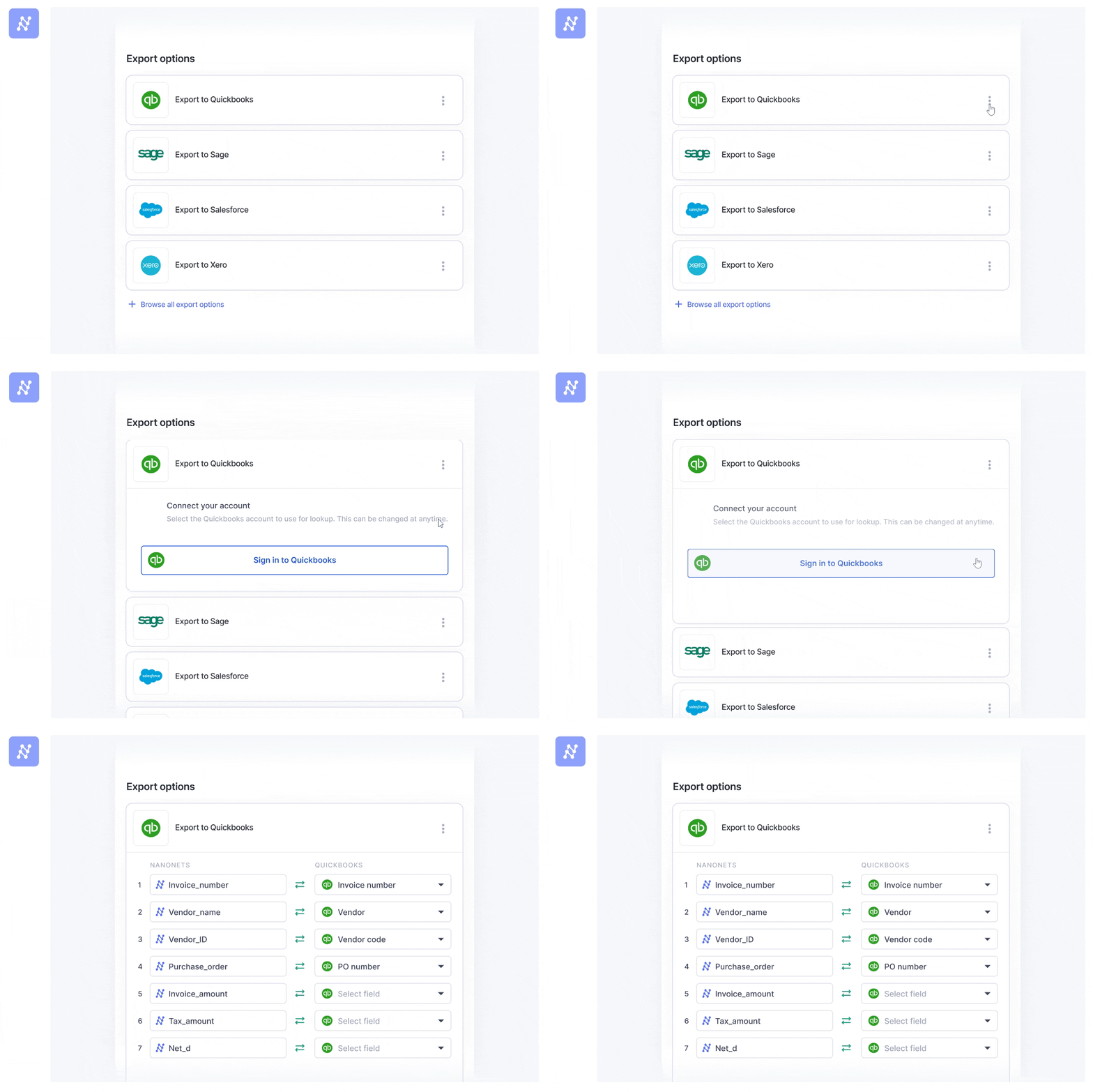
Integrate your existing business tools seamlessly with Nanonets to automate data collection, exports storage, bookkeeping, and much more.
Turn your organisation 10x more productive by allowing teams to focus entirely on core activities while Nanonets handles everything else.
Discover important details about our product.
Bill of Lading (BOL) OCR uses AI-powered technology to automatically capture, read, and extract specific information from Bills of Lading. A BOL is a legal document issued by a carrier to a shipper, detailing the type, quantity, and destination of goods being shipped. It serves as a contract of carriage, a receipt of goods, and a document of title. BOL OCR aims to digitize this crucial document, eliminating manual data entry.
The process typically involves:
Automated BOL OCR significantly reduces manual effort/errors, accelerates logistics, and enhances compliance and visibility in the supply chain.
A robust Bill of Lading (BOL) OCR solution, especially one powered by AI and Intelligent Document Processing (IDP), can accurately extract a comprehensive range of data fields essential for logistics, supply chain, and financial operations.
Key data fields typically extracted from BOLs include:
How AI Ensures Accuracy: Nanonets leverages sophisticated AI models trained on vast datasets of global logistics documents. This allows the AI to understand context, handle layouts agnostically, process scanned/handwritten data using advanced OCR/HTR, extract complex tables precisely, and allows for customization for unique BOL layouts or niche fields. This granular, accurate data extraction transforms unstructured BOLs into structured, actionable information for seamless integration into TMS/ERP.
AI and Machine Learning (ML) fundamentally enhance the accuracy of Bill of Lading (BOL) OCR, especially for complex or varied BOL formats that traditional OCR struggles with. AI enables the system to "understand" BOLs like a human, rather than relying on fixed templates.
By leveraging AI and ML, BOL OCR solutions achieve significantly higher accuracy rates (often 95-99%+) for challenging BOL data, transforming previously unusable documents into structured, actionable information.
Implementing Bill of Lading (BOL) OCR offers transformative benefits for logistics and supply chain operations, significantly enhancing efficiency, accuracy, compliance, and real-time visibility across the entire freight process.
Main benefits:
By leveraging an AI-powered IDP solution like Nanonets for BOL data extraction, companies achieve unprecedented efficiency, accuracy, and control, transforming their supply chain operations.
Yes, absolutely. Automating Bill of Lading (BOL) data extraction significantly accelerates both customs clearance and freight auditing processes. These are often complex and document-heavy stages in the supply chain where manual data handling causes considerable delays and errors.
Here’s how automating BOL data extraction achieves this acceleration:
By providing accurate, structured data from BOLs quickly, automated solutions transform these critical compliance and cost-control processes from bottlenecks into highly efficient, accelerated workflows.
Bill of Lading (BOL) OCR is a pivotal technology in freight forwarding operations, streamlining numerous processes from initial booking to final delivery and billing. Freight forwarders manage complex logistics involving various carriers and vast document volumes, making automation essential.
Here’s how BOL OCR is used in freight forwarding operations:
By transforming manual BOL processing into an intelligent, automated workflow, freight forwarders can achieve unprecedented efficiency, accuracy, and visibility, gaining a competitive edge in global logistics.
Integrating a Bill of Lading (BOL) OCR API into your existing enterprise systems (like a Transportation Management System - TMS, Enterprise Resource Planning - ERP, or Warehouse Management System - WMS) is crucial for automating logistics workflows and ensuring seamless data flow. This eliminates manual data entry and extends your existing software's capabilities.
Here’s how to integrate a BOL OCR API:
By following these steps, you can embed powerful BOL OCR capabilities into your existing systems, automating data entry and streamlining your entire logistics workflow.
Automating data extraction from Bills of Lading (BOLs) presents several common challenges, mainly due to their high variability, complex data structures, and varying document quality, making reliance on traditional OCR insufficient.
Common challenges:
Addressing these challenges requires a strategic approach, focusing on choosing an AI automation platform like Nanonets that offers strong IDP capabilities, flexible integration, adaptive learning, and robust security/support for logistics document processing.
Data privacy and security are paramount for a Bill of Lading (BOL) OCR API provider, especially as BOLs contain sensitive shipping details, commercial values, and potentially customer information. Non-compliance or breaches can lead to severe legal penalties, financial losses, and reputational damage.
Essential data privacy and security measures:
By prioritizing these measures, businesses can confidently leverage BOL OCR APIs to automate logistics processes while rigorously protecting sensitive shipment data and ensuring full compliance with privacy regulations.
The market for Bill of Lading (BOL) OCR APIs and software includes both specialized providers and broader Intelligent Document Processing (IDP) platforms with strong logistics capabilities. The best choice often depends on specific needs, such as volume, integration requirements, and the diversity of BOL formats handled.
Leading providers include:
When selecting a provider, consider the complexity and diversity of the BOLs you process, the required accuracy, scalability needs, integration capabilities with your TMS/ERP, and compliance requirements.